Here's the definition of a tough pick: Choose the best city to visit of the four Northern European capitals: Oslo, Stockholm, Helsinki and Copenhagen.
No matter which one is selected, you probably are right. They are all very, very nice and worth a visit. It helps that all are on the waterfront.
Oslo has been around for about a thousand years. It's easily the most populated part of Norway, with about a 1.2-million people within driving distance. Oslo usually in near the top in world surveys about quality of life. It also is expensive, as is all of Norway.
It can get warm here - the record is 95 degrees. It can get cold here - the record is 14-below. In other words, the temperatures are less moderate than those in, say, Bergen. The parks are pleasant, the architecture is fascinating, and the economy is doing well. No wonder people keep moving here.
I've attached a photo of the city taken from the Opera House, but that's not enough. You need to take a long look around.
Yes, when you think of Oslo, you think of ... the beach.
OK, maybe not. But there is one, right in the middle of downtown. There was a little space left over in the development, and planners decided to turn it into a 100-meter beach. It is located right next to the Opera House.
Happily, the water is quite shallow, so that it's easy for families to go there and cool off on that rare hot summer day. I take no responsibility if you find that the water is too cold for your tastes.
Don't look up when you enter the main part of the Oslo Public Library. You might consider that the building was done on a budget, and then wonder what was keeping that top part up.
The main building is the jewel of a system that stretches all over the city. It was part of the redevelopment program in that portion of Oslo, and it opened in 2020. It won a variety of awards along the way.
The idea was inspire people in the area to come inside and explore new places. The inside is constructed with all sorts of odd angles toward that purpose. It's an interesting place to see, certainly, and deserves a look.
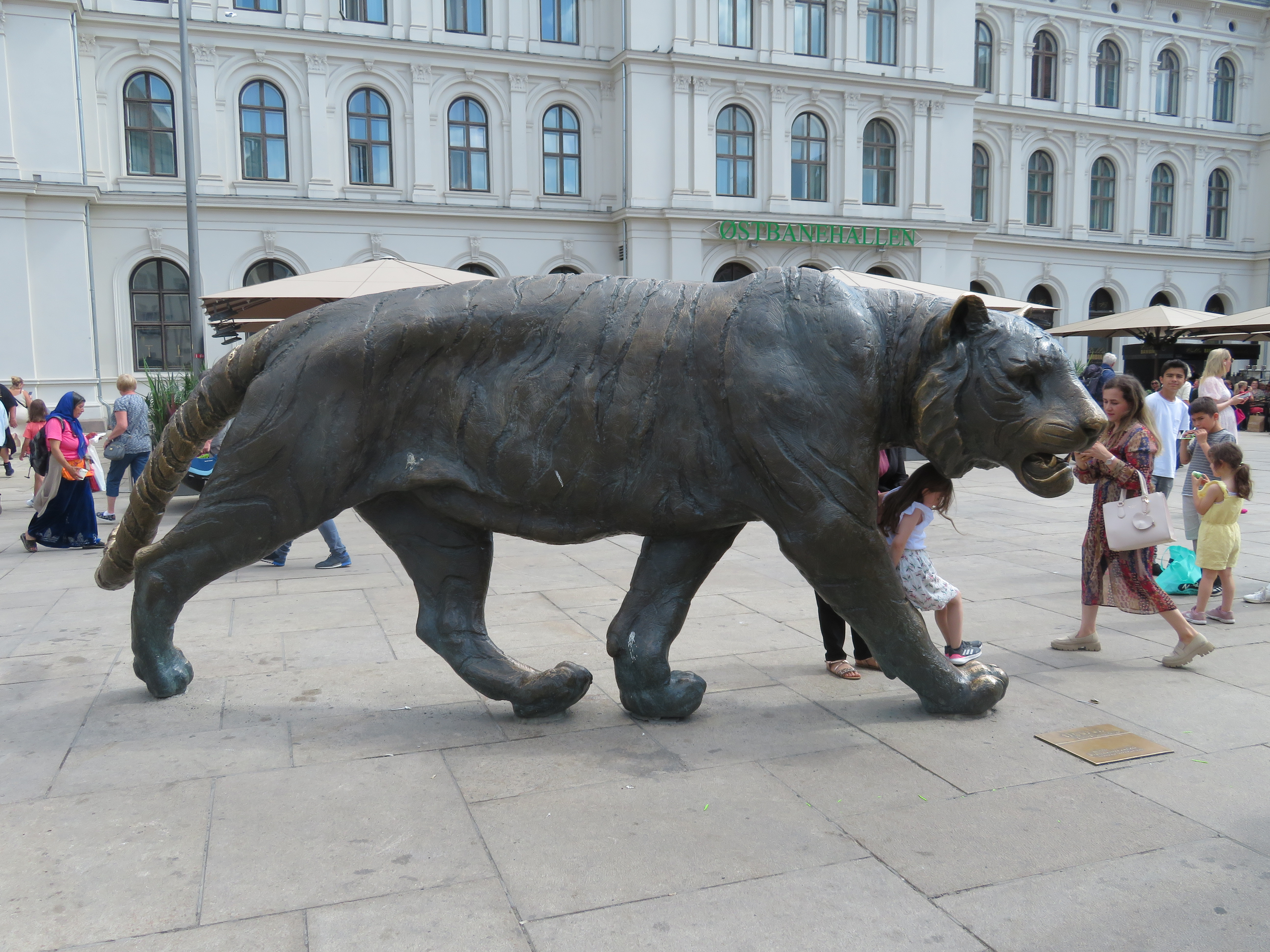
Walk out of Oslo Central Station after a railroad ride and you are welcomed by ... a tiger?
All right, it's a tiger made out of bronze, so there will be no unexpected meals consisting of tourists on the menu. Sure enough, there's a story there.
Oslo's nickname is the Tiger City. In 1870, Norwegian poet Bjørnstjerne Bjørnson wrote a poem, "Sidste Sang," that described a fight between a horse and a tiger. Supposedly, the tiger was a metaphor for the city and the horse represented the countryside. I'll take their word for it. In any event, the tiger doesn't represent danger; it stands for excitement.
On the other hand, some say that the Danish word for beggar was Tigger, and Oslo became known as the city of beggars to some. Switching to Tiger was a reaction to that. The truth? Who knows? It's a nice-looking tiger, though.
It was a gift to the city in 2000; that marked Oslo's 1,000th anniversary.
City Hall looks very impressive on 364 days (365 in leap years). It has a twin-tower construction, with some lovely art work at the main entrance. The back side looks out on the waterfront.
The lobby is particularly well done. There are murals in the hall, dedicated to the time between the World Wars and the occupation period during World War II.
Still, there's one day a year where the place looks especially good. It is on December 10, when the Nobel Peace Prize is handed out. As you'd expect, the place is fixed up quite nicely. After all, the Royal Family and Prime Minister turn out for the occasion.
You probably haven't heard of many of the recent winners, which includes individuals and organizations. Barack Obama was something of a surprise choice in 2009. Jimmy Carter, Nelson Mandela, Mikhail Gorbachev, Elie Wiesel, Lech Walesa, Mother Teresa, Dr. Martin Luther King, and Albert Schweitzer are among the winners. That's pretty good company.
You can see the lobby during a visit, but the rest of the place was closed to tourists during our visit. It is a working office building, so that makes sense.
The National Museum has been around Oslo since 2002. However, the contents were stretched out among several buildings. In less than 20 years, someone had a better idea: consolidation.
Now everything is one place, thanks to the 2022 opening of one giant museum. Contemporary art, decorate art, architecture, etc. - it's all in one place. There's also a giant library with something like 165,000 books available for researchers.
The National Museum is located a short distance from the waterfront in the nation's capital, an appropriate attraction for the area. If you aren't in Oslo, you can go on line and see many items that are part of the collection there.
There's not enough space here to salute and describe the life of Fridjof Nansen, a Renaissance man if one ever existed. His list of accomplishments is simply stunning.
As a boy he was a national champion at cross-country skiing, and decided to study zoology to stay outdoors. That led him to be on the team that staged one of the first explorations of Greenland. He later was part of the Fram expedition to the Arctic. Early in the 1900s, he was one of the leaders of the faction in Norway that wanted the country to be completely separate from Sweden. Nansen won that argument in 1905, and was the country's first minister in London. That didn't last too long, as he resigned to study oceanography.
But he went back to government work in World War I, and was a key representative for Norway during the early years of the League of Nations. In that role, he played a huge part in the return of many thousands of prisoners of war to their homes. One of the problems along the way was that refugees in the early 1920s had no proof of identity. He created the "Nansen Passport," which was accepted by more than 50 countries as such proof. His work first was directed at Russians, but soon expanded to other groups in peril. That earned him the Nobel Peace Prize in 1922, and the story is honored on the wall of City Hall.
Nansen worked in other international projects throughout the 1920s, but died in 1930. He's been the subject of several honors since then; he even has a crater on Mars named after him. Here's more on Nansen's life:
You've probably heard about Thor Heyerdahl, billed as a "Norwegian adventurer." His life is definitely worth exploring, pardoning the pun.
He did something that seems almost inconceivable in hindsight. He constructed a raft called the Kon-Tiki, which was made of balsa wood. You might not be interested in going from one side of a stream to another like that, but Heyerdahl had bigger goals. He rode it from Peru to Polynesia in 1947. That's rather preposterous. Yet he had the foresight to photograph the experience. The result was made into an award-winning documentary.
Heyerdahl went on other journeys as well, exploring the world to promote care for the environment and world peace. The museum first was opened in 1949 to hold the Kon-Tiki, and it has become bigger to hold the Ra II. Thor took that one from North Africa to the Caribbean.
This is located right next door to the Fram Museum, so it's an easy double-header.
Norway was a world leader when it came to the exploration of the earth's poles. You could see how someone from that country was tempted to zip up north to find the North Pole. Apparently they thought the South Pole would be a snap after that. This is a tribute to those exploring pioneers.
The "Fram" in the Fram Museum is a boat, which is billed as the strongest polar ship ever built. It was used between 1893 and 1912 by Fridtjof Nansen, Otto Sverdrup, Oscar Wisting and Roald Amundsen. The idea was that the ship's design would push it above the ice, so that it wouldn't be crushed in the frigid waters. It worked quite well.
Amundsen used it when he discovered the South Pole in 1912. Then he returned home, and the Fram went into storage. After some years in which the boat was allowed to decay, a group thought it was worth saving. So after some rehab, the Fram stands ready for your inspection. You can walk along the top deck, just like those intrepid explorers did more than a century ago. You can also get a peak at the sides.
The ship is surrounded by various artifacts of the journey. The museum also contains a room designed to recreate the feeling of the explorers. It's kept at about 25 degrees and the floor resembles that of the Fram. In other words, it's like going to a Bills' home game in late November. The room is an interesting idea for a museum.
The Fram Museum calls itself the best museum in Norway. It may have a point.
Frogner Park is the biggest park in Oslo, and it's the biggest tourist attraction in Norway. It's big and beautiful, a perfect place for a walk in the sun or a chance to count the 14,000 roses on display.
Its most famous section is the Vigland Sculpture Park - an informal nickname for the area. You won't find a bigger area dominated by the work of one may anywhere else. The city gave Gustav Vigland a home and office when his home was going to be blown up to make room for a library. The deal was that in return he agreed to donate his work to the city. Gustav got to work in 1924, and kept his word over the last 20 years or so of his life.
There are 212 sculptures on the grounds, and the effect is a little overwhelming. That's a lot of art. When he died, his office was turned into a museum of his work.
Talk about your heroes. Gunnar Sonsteby is overqualified for that title.
Sonsteby was born in 1918, and went to college in Oslo. He was working as an accountant in 1940 when the German invaded Norway. Gunnar quickly decided to join the Norwegian Resistance, From there it was on to service with the British as a spy. Sonsteby was imprisoned for three months in Sweden, but convinced authorities they had the wrong Gunnar Sonsteby and was released. The Gestapo caught him in 1943, but he escaped and headed to Sweden. Eventually Gunnar was parachuted into Norway, and became the leader of a saboteur group. They stole plates for currency, blew up offices, and destroyed several ships. Through disguises and forged papers, Sonsteby never was captured.
The Nazis eventually lost their grip on Norway, and Gunnar was one of the first to welcome Crown Prince Olav back to his homeland in 1945. After some time in America, Sonsteby eventually moved back to Norway, and lectured all over the country on the lessons of World War II.
He's the only person to be given the War Cross with Three Swords, the top military honor in Norway. He was awarded the U.S. Medal of Freedom, and a similar honor from Great Britain. And that's just for starters. Sonsteby died in 2012, and was given a state funeral.
The man who was nicknamed "The Chin" deserved everyone of those honors - including this statue in Oslo.
You'd expect a place like this to be fit for a King.
And so it is.
The Royal Palace has been around since 1849, when King Oscar moved in. It was actually started before that and designed for King Carl Johan, but he died before he could move in. His Royal Highness did get to lay the foundation in 1825. When Norway became a separate country shortly after 1900, it became quickly obvious that the building was too small. A good-sized construction project followed.
The current King and the Queen not only live there, but they work there. Heads of state from foreign countries turn up here, official dinners are staged here, and the Royal Court calls this its office.
The building is surrounded by the Palace Park, one of Oslo's oldest and best greenspaces. Seven statues are on the grounds, including one for King Carl Johan. Well, at least he gets to see the area this way.
Public tours of the place have been going on since 2002, and they proved popular. There is a daily changing of the guard, which always attracts tourists in droves no matter what country is the host.
This statue is different than all the others around Oslo ... if not almost anywhere.
Cecilie Flatval, who lives in suburban Oslo, was diagnosed with breast cancer at the age of 42. It was incurable.
She decided to take action in an unusual way - pose for a statue that would be placed in the middle of Oslo. It was the first such monument in the world. Let's let her words take it from here:
For my loved ones, the statue will mean having a place to go. Like a
memorial site. Although I like to focus on living here and now, death
will come. The statue will hopefully be able to give value to others. An
opportunity to talk about a difficult topic. What are we seeing? Me,
partly undressed. Which is not entirely uncommon. But at the same time,
we see something else. Behind this statue, which represents metastatic
breast cancer, we find women of all ages, in different family
situations, ethnicities and social backgrounds. We all show people
peices of who we are, but not everything, and with this project I show a
piece of who I am and my values. Especially to my kids who live with a
mother with cancer. As a mom I want to be there when my children need
me. But I am not always going to be able to be here to tell them that
everything will work out. Telling them it's going to be fine.
To
a large group of patients, mothers, and relatives: We are only here
while we are here, and the rest is history. Just like this project. A
statue, a memory, an opportunity for reflection. Part of me as a
metastatic breast cancer patient. Part of me as an ordinary woman. The
project gives me an opportunity to help make the patient group with
metastatic breast cancer visible. We are so much more than just a
patient group. This is maybe the most important part about the statue.
The statue was unveiled on June 20, 2022. Come to think of it, that was a year and two days before our visit. It is said that awareness of this health issue has been greatly raised by this unusual approach.
This is quite a nice setting for a statue in the center of Oslo, and you'd have to think someone thought highly of the subject to place a tribute there. So it is for Henrik Wergeland.
This was a man who loved words. He wrote plays, poems and history. Wergeland's interests were all over the map, from theology and politics to science. It sounds like Wergeland didn't suffer fools easily, and had a lot of arguments along the way. He asked the Norwegian Parliament to repeal its prohibition on Jewish immigration in 1839. They agreed to it in 1852, seven years after his death. He picked up the title of Norway's National Poet, and became a symbol of Norway's independence. The man crammed a lot of thought into the 37 years of his life.
It is interesting to note that Oslo is not the only city to host a statue in Wegeland's honor. There is a similar tribute to him in Fargo, North Dakota. Keep in mind that there was a great deal of immigration from Norway to the Midwest in the United States. Fargo beat out several cities for this statue, including Chicago, Minneapolis and Grand Forks.
Norway likes to honor its original leaders in the middle of Oslo. It's just a case that the monuments aren't exactly the size of the Jefferson Memorial.
Johan Sverdrup is the man to be saluted here. He was the fourth Prime Minster of Norway, and the first to have the job after the introduction of Parliamentarianism. Sverdrup had the job from 1884 to 1889.
It wasn't an easy time to be a legislator in Norway. The government was trying to figure out its new political relationship with the King, and there were plenty of disagreements along the way. Sverdrup often couldn't get his political allies to follow him, and it seems he resigned in frustration.
Still, Sverdrup is still remembered for his role in the process. His most lasting legacy is an odd one. A major oil field in the North Sea is named after him. There's a few billion barrels under the ground there, and Norway has started to pull it up. The government puts the proceeds of all such exploration into a special fund for rainy days, and it has become a giant economic engine for investment in companies all of the world. Therefore, Sverdrup has a connection to Norway's well-being even today.
It's at least interesting that one of Oslo's most impressive business locations is right around the corner from the Parliament building. Norway may have some socialist practices, but it doesn't get in the way of a good money-maker.
The Tostrupgarden went up in 1898 or so, as two builders were more or less stitched together. It was inspired by a work at the Chicago World's Fair of 1893, which was partially created by architect Frederick Law Olmsted - someone who is still remembered in Buffalo for his work on the city's layout.
The building has gone through a variety of tenants over the years. The bottom floor has been reserved for shops, while the other floors house businesses. The signs on top have changed over the years. It must be fun to walk into a building like that to start work every day.
Once a year, the Grand Hotel is a rather famous place.
The Nobel Peace Prize is handed out in Oslo every year, and the recipients come to town for the ceremony to pick it up. Naturally, they need a place to stay - some place grand. The Hotel is up for the task. The winner stays in a suite in the middle of the hotel, and sometimes waves to people below from there.
By the way, when Mother Teresa won the honor, she didn't want to be involved in such an expensive place. So she stayed at a nearby convent, and asked that the money that would have been spent on accommodations be given to help the poor. Typical.
The hotel opened in 1874, and is filled with Old World Class. Henrik Ibsen used to eat at the Grand Cafe every day. There are 290 rooms. The major attractions as well as shopping areas are close by, making a great place for a stay.
The Norwegian Parliament building sneaks up a little bit on visitors. It is in the midst of downtown, located at the end of a long city park. It's not obviously separated like the U.S. Capitol is in Washington. Still, it makes a nice impression.
The Storting building dates back to 1866. The government body had been using other halls for meetings, and it was decided to give Parliament its own home. The structure was quite big at the time it opened - too big for just the legislature - and it housed some other agencies until Parliament became bigger and needed more staff. When the Germans took over Norway in 1940, the legislators had to go elsewhere to meet - usually abroad.
After World War II, the facility has grown. A four-story office building was built "behind" it in the early 1950s, and other nearby buildings have become part of the complex. I never got past the park across the street, but we have other ways to see what it's like.
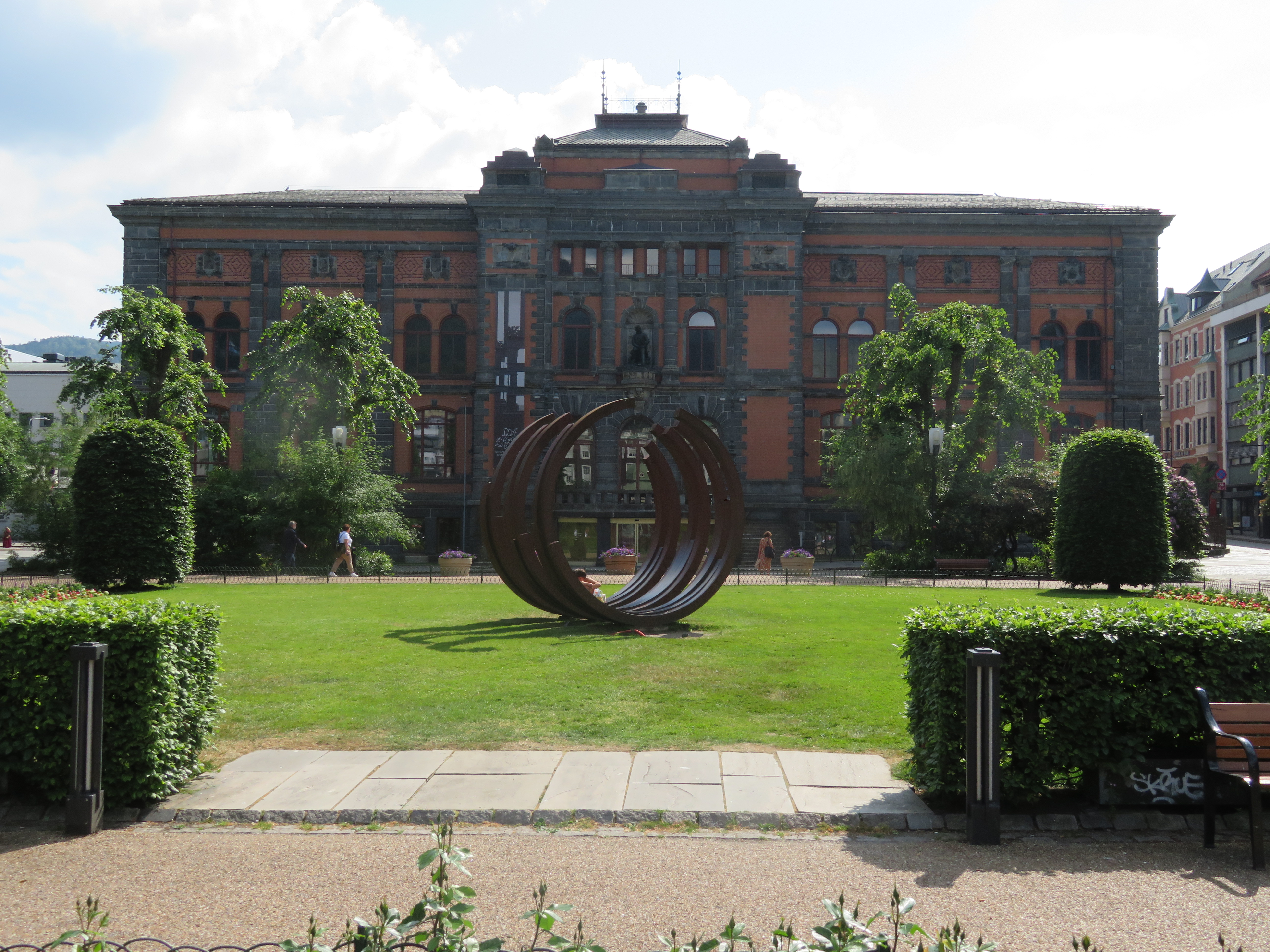
Run for your lives! It's the Creature from Iddefjord!
Oh, sorry. It's just a piece of art that is located in front of the Oslo library.
Martin Puryear is the artist in question here. He said he wanted to construct an ambiguous stone presence that could be
experienced not only with the eyes, but also by direct physical contact. I guess he's done that. Puryear hopes that the Creature refers to something real, and/or something imagined. He cut 40 pieces of granite so they would fit exactly together to form a piece that is more than 20 feet high.
Puryear is from the Hudson Valley of New York State, which means he made quite a few long trips across the pond as he was working on this one. This one was said to be a pleasure for him, since it emphasized his love of books. "Creature from Iddefjord!" is said to be a logical meeting place for those in the area.
Here's a classic example of how I walk around a city. I see something interesting, and snap a photo. Sometimes the object proves interesting, sometimes it doesn't.
This translates to the Freemasonry Lodge, located in downtown Oslo. I'm not going to tell you that I know a great deal about the Freemasons, even though my father was a member for reasons I could never understand. The organization has been in Norway since 1749. The group was said to have about 20,000 members in 2009, and members must be Christians.
Well, I'm not dropping in for a recruiting visit to a secret society. But it is an interesting building.
People throughout the world know at least one piece of work from Edvard Munch. It's a brightly colored, somewhat surrealistic painting called "Scream." Munch lived from 1863 to 1944, and he now ranks as one of Norway's best known artists.
So why not have a museum dedicated to his work?
Done. The original was opened in 1963, to celebrate the 100th anniversary of Munch's birthday. There was talk of a new facility in 2008, but that ran into some political problems over funding. Eventually, the place got built near the Opera House.
In the summer of 2021, about 28,000 pieces of art were carefully moved to the new location. It has about half of the all of Munch's originals pieces of art, and has prints of the rest of them. Throw in some other items, such as plates, books, and other items by different artists, and you have a filled-up museum.
One line about the place stays with me concerning the design. A critic said the museum looks like the world's largest collection of guard rails. OK, now you've got me curious.
Eventually, after visiting the Oslo Opera House, you will look out on the harbor ... and see, well, something on a platform. And you'll think ... "Hmmm."
It is made out of steel and glass panels, and checks in at 39 feet by 56 feet. This piece of art was created by Monica Bonvicini. One of the interesting parts if that is designed to look as if it is adrift in the water in the harbor. Actually, there is a tether to the bottom, so that it merely drifts. That was, the piece of art offers different views depending on the conditions and time or day.
I have read that this was designed to be a three-dimensional version of a painting called "The Sea of Ice" by David Friedrich. Honestly, to me it looks more like an industrial accident that it waiting to be cleaned up. The title was designed to be ambiguous, and Monica certainly succeeded in that goal. One person suggests that it means "She lies ... in different places in the harbor." Hmm.
Still, I always enjoy public art, and this serves as a good conversation piece.
When researching a visit to Oslo, one piece of advice comes quickly and is repeated. "You've got to go to to the Opera House."
Better still - "You've got to walk on the roof of the Opera House."
That may sound a little odd, but it's certainly true. Walking on the roof of Oslo's top tourist attraction has to be done. During our visit, we were thrilled to discover that our hotel was about two short blocks away - so we could do that first thing.
The city fathers decided in 1999 that a new Opera House was needed, and hoped it could be the centerpiece of urban development. It took four years to come up with a design for it, and they didn't even gulp at a budget above $700 million. (Happily, it was $52 million under budget when it was done.) The facility opened in 2008, and more than one million people visited in that first year. Who says opera is highbrow?
Actually, anyone would enjoy a visit. From the water, the structure is designed to look like a glacier, and the white Italian marble helps serve that purpose nicely. The genius of the design is that it just invites people to walk up the roof and get a better view of the surrounding area. It can be a place for people to watch events. I'd have to guess that it's a great place to watch a fireworks show.
The main auditorium seats 1,364, and there are other rooms for performances. Plus, others work there full time. I'm told the doors to the ladies' room are spectacular. It's all part of an urban development project. In the area are other public buildings, hotels, apartments, and offices - all near the central train station, a place of vitality. You'd have to say it has worked as planned.
We couldn't get into the actual performance area. No videos show it either. But we can at least get a better look around here.
It's a good-sized ride from Flam to Oslo, and a couple of stops along the way to stretch out are always a good idea. Seeing the Borgund Stave-Church is a good reason to delay the trip for a while.
After all, how often do you see an 800-year-old church in some place other than a big city?
Most churches of this type were built between 1130 and 1350, but the plague of that era generally stopped most construction projects. The Norwegian versions are the only ones that have survived to this day. Twenty-eight are still standing, and the Borgund version has the fewest alterations of any of them.
The inside of the place is a little like a plus sign. An altar is at one end, and entrances open from two others. It's fair to say that the church never had a big congregation, because it's tough to fit more than maybe a couple of dozen people in there. Very little daylight gets in; during our tour a big flashlight was needed for illumination.
In 1868, this structure became a museum, and a new church was built next door. I was a little surprised that our guided tour did not visit the new place, which is still standing. Happily, there's a rest stop just down the road that can handle a tourist's necessities.
Someone is going to have convince me that this isn't the most scenic railroad ride in the world. This runs from Myrdal to Flam, and the trip is spectacular - filled with steep cliffs, rivers, waterfalls, etc. It's about 20 kilometers (12 miles) long.
It wasn't easy to build this attraction, which ranks third among Norwegian destinations. Almost all of the 20 tunnels were dug by hand. No wonder it took from 1924 to 1940 to construct it. Supposedly the Germans applied the finishing touches after taking over the country in 1940. The line allowed the people around Flam to take a train to Oslo or Bergen, which "de-isolated" the entire area. The drop in elevation along the way is about 2,800 feet, and the train averages about 25 mph. It takes about an hour to go from one end to another. (Of course, you can go the other way too.)
It should be mentioned that you have to get from Oslo or Bergen to Myrdal to ride this train down to Flam, and that's no hardship. That part goes uphill, and the scenery gets better and better with each rise in height.
There might be a surprise waiting for you at the end. The train station area doubles as a port for the ships that come in. Flam is right on a large fjord, and large cruise ships often make the trip up to that town. In fact, one was waiting for us when he got off the train. There's a nice little store area in that transportation complex, with plenty of souvenirs, avisitor center, etc.
Flam has become a resort area on its own. It seems like a great place for hiking, skiing, or just plain gawking.
I have some good photos from the trip, but many were slightly spoiled by the fact that it was necessary to shoot through the train windows. Not much that I could do, but you can watch the unspoiled video:
The Flam Railway has one special stop on its line, and everyone gets off for it. It's Kjosfossen, a powerful waterfall in the midst of the mountains.
An estimated 900,000 take a look at the waterfall for a few minutes. They walk away a little bit wet, as the water does tend to have a spray associated with it. (Be prepared to clean your glasses.)
The waterfall is 225 meters long, and 93 meters high. Here's the fun part - there's a hydroelectric plant at the site of it, and power is generated to used on the Flam Railway.
By the way, you really can only see it by getting on the railroad. But, realistically, you do want to take that ride.
The video does a good job of showing the experience.
Timing is important to any musician, and as we shall see, it was particularly true in the life of composer Edvard Grieg. It becomes apparent when visiting his home in a suburban part of Bergen - located right on a beautiful lake in a residential area.
Grieg was born in Bergen in 1843, and his mother was his first piano teacher. He showed talent almost immediately, to the point where famous violinist Ole Bull said that Edvard should attend the Leipzig Conservatory. He did so, and did well. Grieg's concert career started in 1861, and soon he was composing as well as writing. Edvard piled up the credits from there. His best known work comes from "Peer Gynt," which has been used in cartoons for decades. Grieg died in 1907.
But before that, he had become considered the musical voice of his country, Norway. This is where the timing comes in. That nation finally split apart from Sweden in 1905, and certainly there was a great deal in anything Norwegian at that time. Grieg's music was one of the country's most popular exports. Certainly that fact helped his reputation in and out of Norway for years to come.
Edvard and Nina had a nice house, and you can still go through the bottom floors of it. In fact, his piano from those days is still on display. You can see Eddie standing at the end of the patio in the photo; based on what I've read, he was a little challenged in the height department. The area has an admissions area/small museum/cafe by the entrance. Interestingly, it also has a nice concert hall built into the grounds, as to not detract from the scenery. It holds perhaps 500 people, and the museum brings in pianists to play Grieg's music only a short walk from his final home and his grave. It really should be part of any visit.
One other note: Originally, the tour company wanted to charge us $140 for the trip to the Museum and its grounds. However, the opportunity was cancelled. We ended up going by taxi, and spent $40 each for the entire trip. Keep that in mind, please.
You probably don't know much about Bergen, Norway's second-biggest city, if you haven't been there. I didn't. There's a lot to like.
The population is close to 300,000, with some of the residents living on the islands near the city. (Note: Norway's coastline has A LOT OF ISLANDS.) Bergen also is surrounded by mountains, so flat space always has been at a premium.
But the place also has a harbor, and that's been a key to its economic development over the years. Fishing and trading have been important for centuries. Some of the waterfront has been preserved from past eras, which is a treat to see in person. Bergen was the capital of Norway back in the 1200s.
The harbor is still important today, but in a different way. About 300 ships a year, filled with tourists with money, show up there. By the way, about half are either German or British. That means that those who speak German and English probably can get around quite nicely. They jam the old part of town, fascinated by buildings like the one shown here. What's keeping that room up, anyway?
One reasons for its popularity, internally and externally is a mild climate. The average high in the summer is in the 60s, and the average low in the winter is around the freezing mark. There are colder places in Norway, so this works pretty well.
And the views of downtown, thanks to some surrounding mountains, are fabulous. We need to look around.
Ole Bull was one of the big music stars of his era in the 1800s. The violinist is buried in downtown Bergen, so it's no wonder that he receives a tribute nearly.
This is it - a fountain in his honor and memory. He's the guy on top of the rocks playing the violin. Below him is a skald playing a mythical harp. A skald is a Norwegian poet who sang songs for kings for a few hundred years starting in Viking times.
This is a relatively rare photo of the area without kids playing on the rocks. Or so I'm told.
This started out as a simple photo of some public art. Turns out the building behind it - the West Norway Museum of Decorative Art - was the attraction.
The museum started in 1887, but a fire nine years later forced a move into another building. Another fire took place in 1916, but the structure was saved. It holds items in silver, furniture, glass, porcelain, and textiles.
The Bergen Art Gallery used to control the top floor of this building, but that moved to a new home down the street. Now the Museum of Decorative Art concentrates on crafts, with many from China thanks to a donation from a benefactor.
The China Collection was the subject of a couple of thefts in 2010 and 2013. The complex relationship between Norway and China has gotten in the way of investigating the crimes fully.
Byparken is the biggest city park in Bergen, and it's probably the best place to enjoy a nice day. One of the features that adds a little charm to the area is a music pavilion.
It seems that some greenspace in the area was created in 1865 by accident. Fires will do that in the good old days. More than 180 homes were said to be destroyed. The cast-iron pavilion went up as a replacement. The building was gifted to the city in 1888.
The building collapsed and needed to be rebuilt around 1999. Afterwards, it went back to its job of hosting small musical performances and adding some beauty to the area.
As the short video indicates, this is in a lovely spot.
The Bergen Art Museum hasn't taken over the entire downtown area of the city yet, but it is working on it. The facility has expanded several times over the years, and in the process it has become one of the largest museums in Norway.
The museum contains about 9,000 works of art in all, and it is spread out over four of buildings. If you are serious about this stuff, better allow some time to see it all.
There is work by Edvard Munch, Harriet Backer, Nikolai Astrup and J. C. Dahl on display, and there are a couple of restaurants in the building if you get hungry looking at everything.
By the way, the building in front used to host Bergen's power company. In 2003, it was turned into a museum after some construction work. That has to be a first.
It's the tallest statue in Bergen's biggest park. Therefore, it must be someone important to the city and/or country, right?
Absolutely. The subject here is Christian Michelsen. He was the first prime minister of Norway, and he was the man who proclaimed in 1905 that Norway was an independent nation and no longer part of Sweden.
Michelsen stayed in office through 1907, when illness forced him to retire from the job. He helped form a new political party in 1909 but didn't lead it, and decided to leave public life a year later. Michelsen died in 1925.
You should notice the bird on top of Michelsen's head, taking a look at the surroundings. I took a close-up of that, and it would seem that this particular bird wasn't the first to use Mr. Michelsen's head for, um, personal reasons. It's funny how many times a bird happens to be on a statue's head when you have a camera out.
By the way, Michelsen also has a statue in his honor in front of Oslo's Parliament. It's much smaller than this one, but probably has fewer birds visit.